Pascal's Triangle
LeetCode 118 | Difficulty: Easy
EasyProblem Description
Given an integer numRows, return the first numRows of Pascal's triangle.
In Pascal's triangle, each number is the sum of the two numbers directly above it as shown:
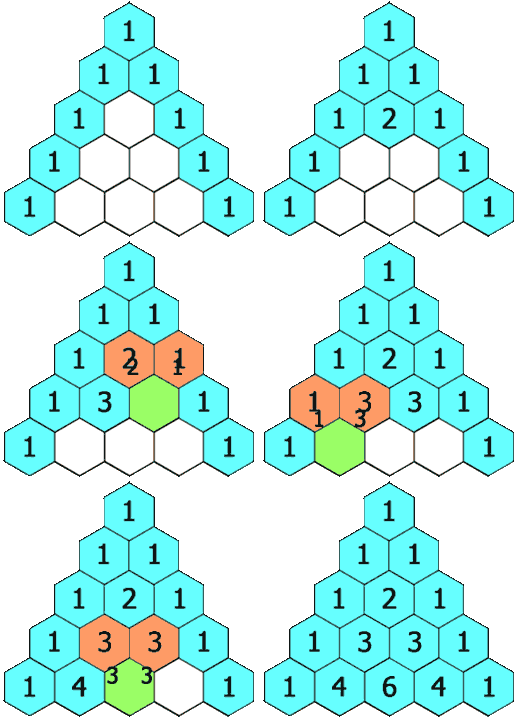
Example 1:
Input: numRows = 5
Output: [[1],[1,1],[1,2,1],[1,3,3,1],[1,4,6,4,1]]
Example 2:
Input: numRows = 1
Output: [[1]]
Constraints:
1 <= numRows <= 30
Topics: Array, Dynamic Programming
Approach
Dynamic Programming
Break the problem into overlapping subproblems. Define a state (what information do you need?), a recurrence (how does state[i] depend on smaller states?), and a base case. Consider both top-down (memoization) and bottom-up (tabulation) approaches.
When to use
Optimal substructure + overlapping subproblems (counting ways, min/max cost, feasibility).
Solutions
Solution 1: C# (Best: 216 ms)
| Metric | Value |
|---|---|
| Runtime | 216 ms |
| Memory | 25.2 MB |
| Date | 2019-12-15 |
Solution
public class Solution {
    public IList<IList<int>> Generate(int numRows) {
        	IList<IList<int>> rows = new List<IList<int>>();
	for (int i = 0; i < numRows; i++)
	{
		rows.Add(new List<int>());
		for (int j = 0; j <= i; j++)
		{
			if (j == 0 || j == i)
			{
				rows[i].Add(1);
			}
			else
			{
				rows[i].Add(rows[i-1][j-1] + rows[i-1][j]);
			}
		}
	}

	return rows;
    }
}
📜 1 more C# submission(s)
Submission (2017-11-11) — 522 ms, N/A
public class Solution {
    public IList<IList<int>> Generate(int numRows) {
	IList<IList<int>> rows = new List<IList<int>>();
	if(numRows==0) return rows;
	rows.Add(new List<int>() { 1 });
	if(numRows==1) return rows;
	rows.Add(new List<int>() { 1,1 });
	if(numRows==2) return rows;
	for (int i = 2; i < numRows; i++)
	{
		var row = new int[i+1];
		row[0]=1;
		row[i]=1;
		for (int j = 1; j < i; j++)
		{
			row[j] = rows[i-1][j-1]+rows[i-1][j];
		}
		rows.Add(row);
	}
	return rows;
    }
}
Complexity Analysis
| Approach | Time | Space |
|---|---|---|
| Dynamic Programming |
Interview Tips
Key Points
- Start by clarifying edge cases: empty input, single element, all duplicates.
- Define the DP state clearly. Ask: "What is the minimum information I need to make a decision at each step?"
- Consider if you can reduce space by only keeping the last row/few values.